

What do you buy when you buy a broker jet card?
18 September 2026 - 10 Minutes read
What a $232m broker pausing flights says about the jet card.
Table of content
Over the Labor Day weekend in the US, which falls between September 5th and 6th in the USA, a Colorado-based charter broker offered its customers a deal that was hard to refuse and probably harder to explain. Put down $250,000 in cash, and ONEflight International would credit your account with $500,000 in flights. It was a continuous stream of such promotions from a company that had spent a year buying attention to scale: title co-sponsor of the PGA Tour stop in Myrtle Beach, sponsor of the Mastercard McLaren Formula 1 Team in January, and television advertising featuring Shark Tank’s Robert Herjavec and Hall of Fame quarterback John Elway (Forbes).
Three weeks later, on September 16, ONEflight posted a notice on its website. It was pausing “all flight activity for the next 30 days, or until further notice,” while it conducted a comprehensive evaluation of its operations (Private Jet Card Comparisons). More than $150 million that customers had already paid for future flights sat on the other side of that sentence, and to make it worse, the company’s CEO confirmed it does not hold customer funds in escrow (AeroTime).
The question that the industry is asking this week is what went wrong at ONEflight. It is the wrong question.
The more useful one is why anyone expected it to go right.
The Product Nobody Describes Accurately
A jet card is sold as a convenience. You prepay for hours, 10, 25, 50, or 100 hours, and in return you get flexible on-demand scheduling, a guaranteed call-out window of roughly 6 to 48 hours, and a contracted hourly rate protected from market price swings. Fixed-rate cards typically bundle a replacement aircraft at no extra charge if the original goes technical, and cover costs like de-icing that can exceed $10,000 on a large aircraft.
From a seller's perspective, it is all about getting the customer, but at inflated risk that they dont often realize. The broker has sold a fixed-price forward contract with guaranteed availability, regardless of the underlying cost.
What $232 Million in Revenue Actually Means
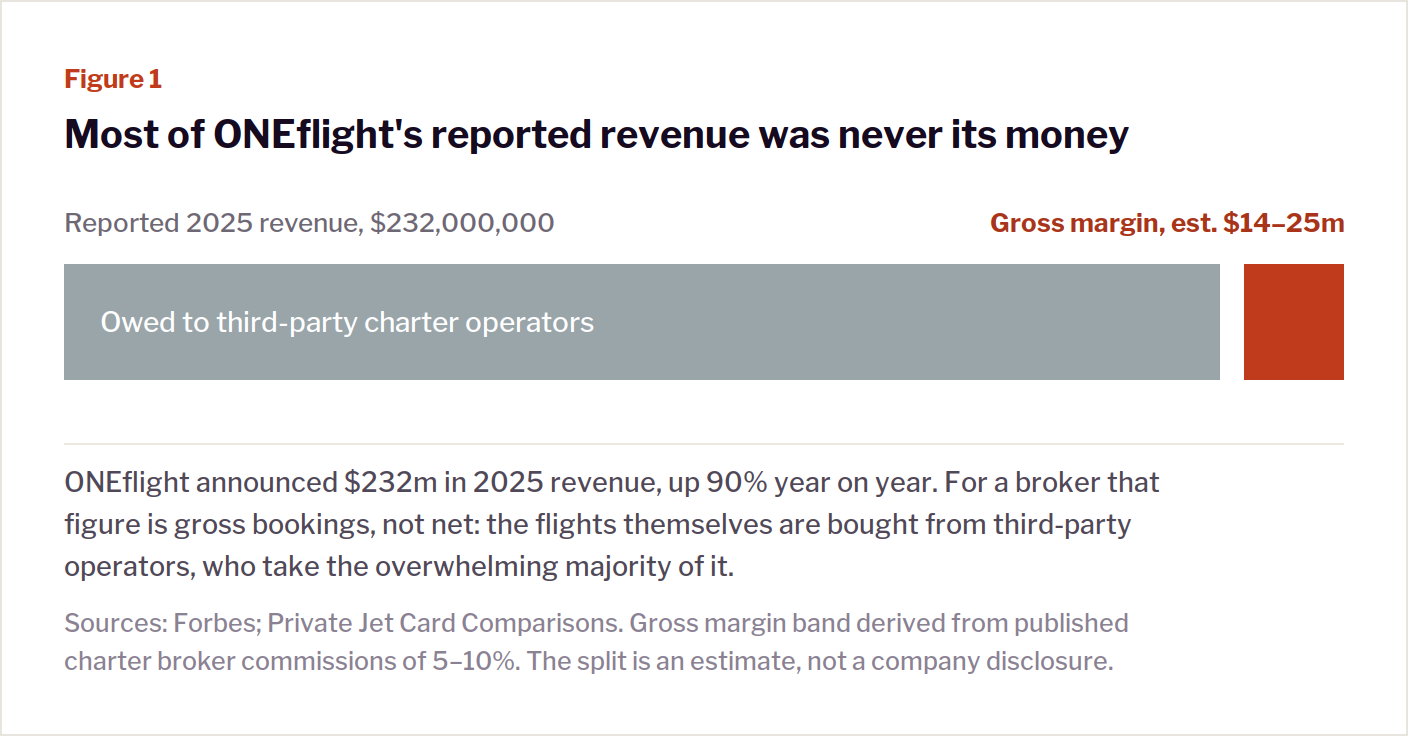
In a January press release, ONEflight announced $232 million in 2025 revenues, which includes flight revenues, up 90% year-over-year. For a charter broker dealing in a single category, backed by superstar advertisements and sponsorship deals, that is an extremely strong number.
However, before that number does any work, it needs decoding. For a broker, “revenue” is ambiguous, and that ambiguity is flattering. If a broker does $200 million in net revenue, the underlying booking value will look north of two billion dollars, which is not credible for a company of that size. Furthermore, if you are doing $2 billion in booking revenue in private aviation, you will have monopolistic control of the market.
Charter broker commissions typically run 5% to 10% of the total charter cost, though the range is wider and less disciplined than the industry likes to admit. One 2026 analysis puts brokered margins at 10% to 30% of the underlying flight cost on high-demand routes, noting the amount is unregulated, unstandardised, and not required to be disclosed as a separate line item.
Take the generous end of the honest range. On $232 million of gross bookings, ONEflight’s actual gross margin pool was somewhere between $14 million and $25 million. That is the money that had to cover salaries, rent, technology, a national TV campaign, a Formula 1 team, a PGA Tour sponsorship and celebrity ambassadors.
With a fixed hourly rate on one side and rising costs on the other, that gap only narrows.
A Brief Timeline of Events
August 25th: ONEflight emails clients with contracted rates stating that it is imposing a 35% “economic surcharge” on reservations, then rescinds it hours later after customer backlash (Private Jet Card Comparisons).
Early September: In a closed industry forum, several charter operators say they have had recent payment issues and are owed more than six figures, while other creditors report no lapses and payment as recently as August (Private Jet Card Comparisons).
September 9th: An internal email from the VP of Human Resources circulates, stating that the CEO “is actively addressing the financial and operations issues that developed under the previous CFO’s leadership.”
September 16th: ONEflight confirms it is pausing all flight activity for 30 days (TheStreet).
The Arithmetic of a Brokerage
Here is the number that tells the story of a brokerage selling a jet card:
On a 7% gross margin, a 7% adverse move in charter rates eliminates 100% of the gross profit.
Charter rates move more than 7% in a quarter routinely. They moved considerably more than that this year. Several smaller charter carriers did not survive the spike in jet fuel prices at the start of 2026 that followed the U.S.–Israeli strike on Iran, and fuel surcharges have risen and fallen with jet fuel prices ever since.
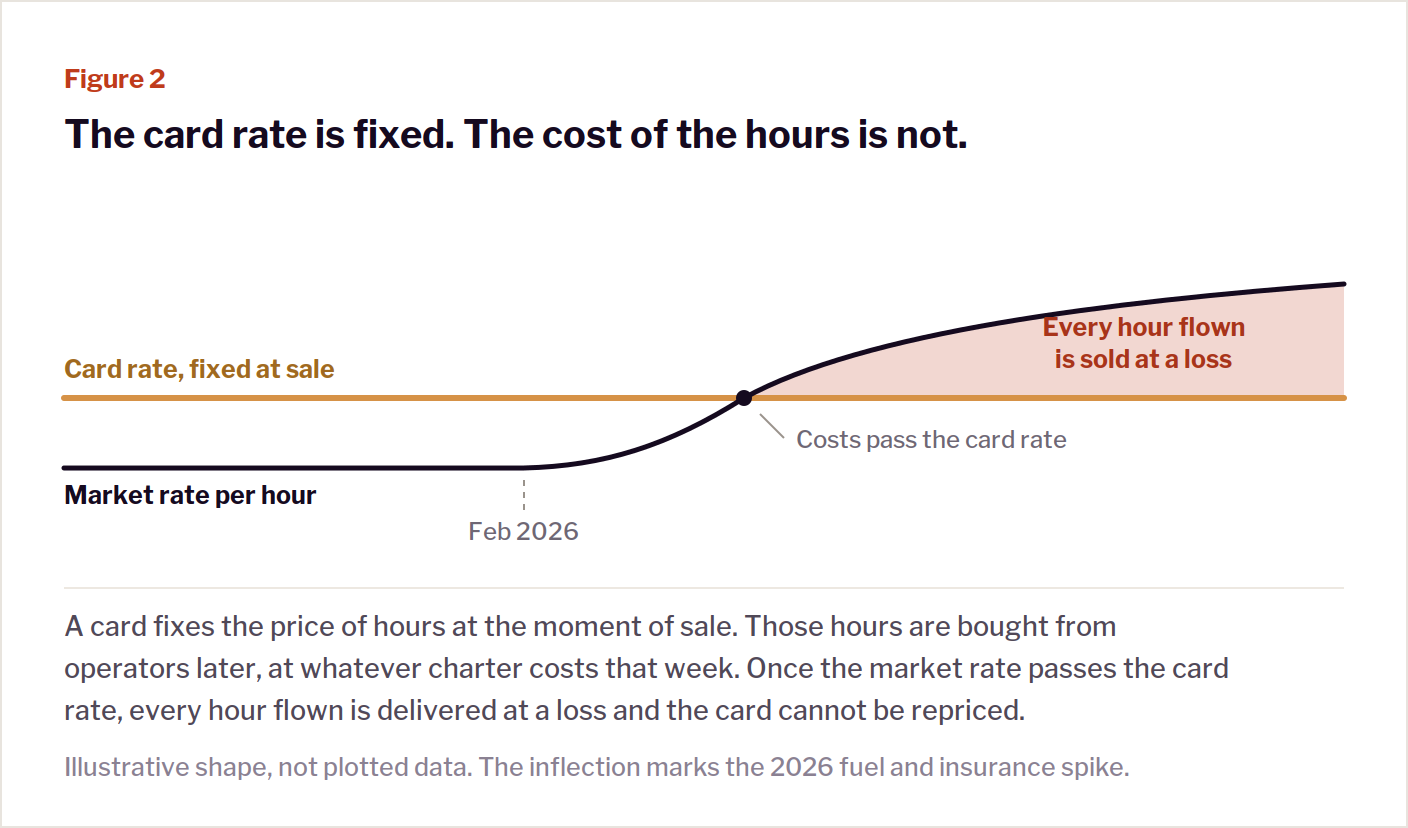
An operator with its own fleet experiences that spike as a cost increase it can pass to the end-user. When a charter operator sells a jet card, it almost always carries a fuel surcharge clause that protects the operator if fuel prices spike. A fixed-rate broker, even with a fuel surcharge, is not protected in the same way, because it is not contracted to an underlying cost structure. It is committed to a single price, so while the market swings, it cannot adapt. It has to absorb the cost or refund the deposits.
One could compare this to a margin call in finance, where a leveraged position becomes unsustainable due to losses and, because of the leverage, those losses are amplified. To keep the position alive, the bank and brokerage asks you to add funds to your account. You do that by selling other positions or by using your cash.
Here is the speculation: ONEflight got a margin call as soon as it was unable to service clients at the price it had promised, and its marketing costs caught up with it.
But Owning Aircraft Does Not Save You Either
The obvious reaction to all of this is to buy from someone who owns planes. The record does not support it.
Zetta Jet operated large-cabin aircraft and went into Chapter 11 in 2017 owing vendors and flyers over $50 million (Forbes). Imagine Air shut in 2018. JetSuite filed Chapter 11 in 2020 and cost jet card members over $50 million. Jet It grounded its HondaJet fleet in 2023 and later filed Chapter 7. Verijet, flying leased Cirrus aircraft, filed Chapter 7 last year with $10.5 million in unused jet card balances.
The clearest case is Wheels Up. In 2023 it held $692 million in customer deposits, owned a large fleet, and still came within a whisker of filing. What saved it was not the aircraft. It was Delta CEO Ed Bastian leading an investor group that put $500 million into the company (Forbes).
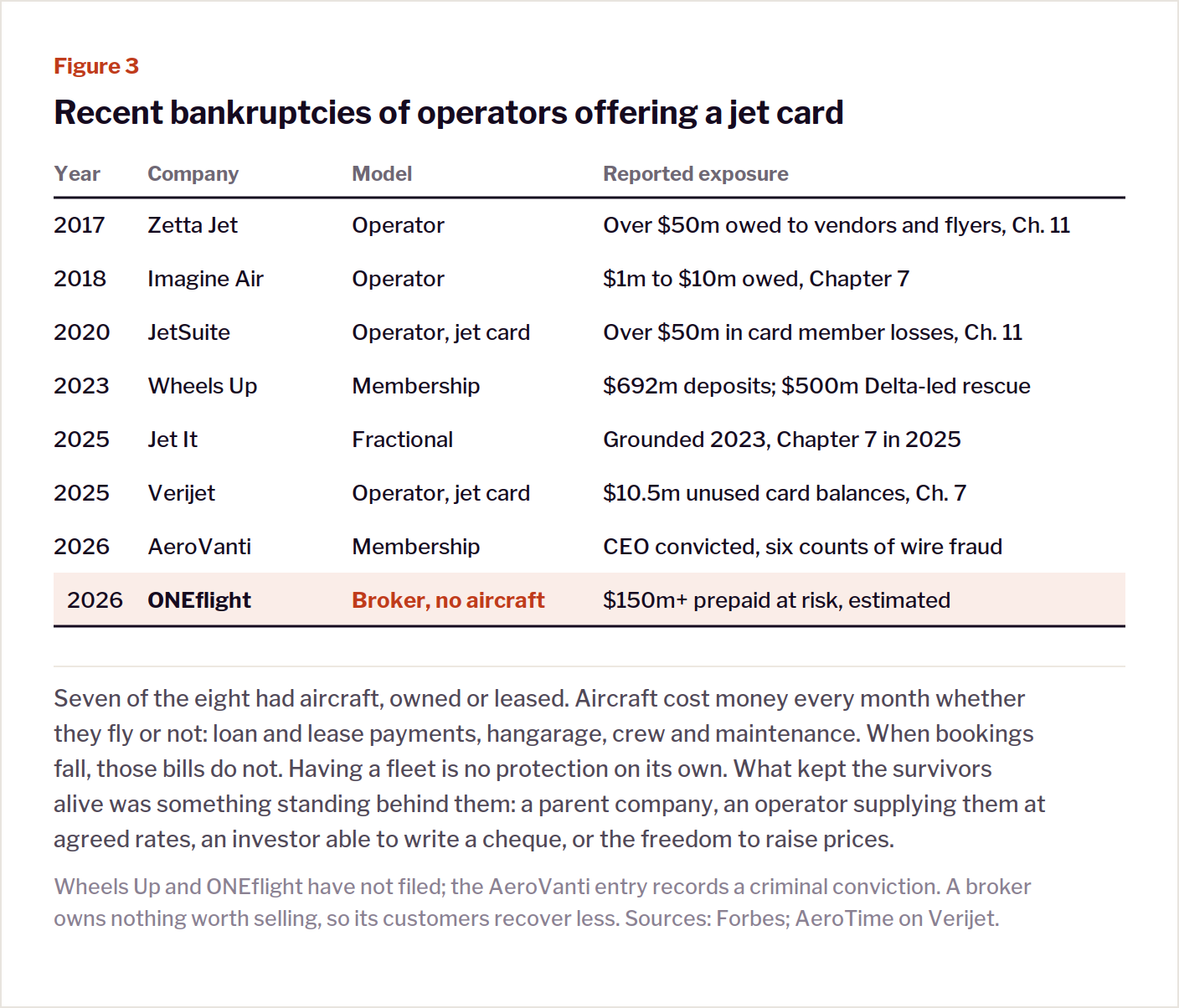
Aircraft are not a revenue safety net. They cost money every month whether they fly or not: loan and lease payments, hangarage, crew and maintenance. When bookings fall, those bills do not.
What separates the companies still trading is not ownership. It is a hedge against the position they have taken: an owned fleet, an affiliated operator supplying them at contracted rates, a parent balance sheet that can write the cheque, or the simple right to reprice when their costs move.
Pick at least one.
A broker that has none of them is in the worst position of all. When an operator fails there are aircraft, slots and a certificate to sell. When a broker fails there is a CRM and a brand.
What Can Private Jet Users Do?
If you are a frequent flyer and are contemplating a jet card, here is what you should do and think about before committing to anything.
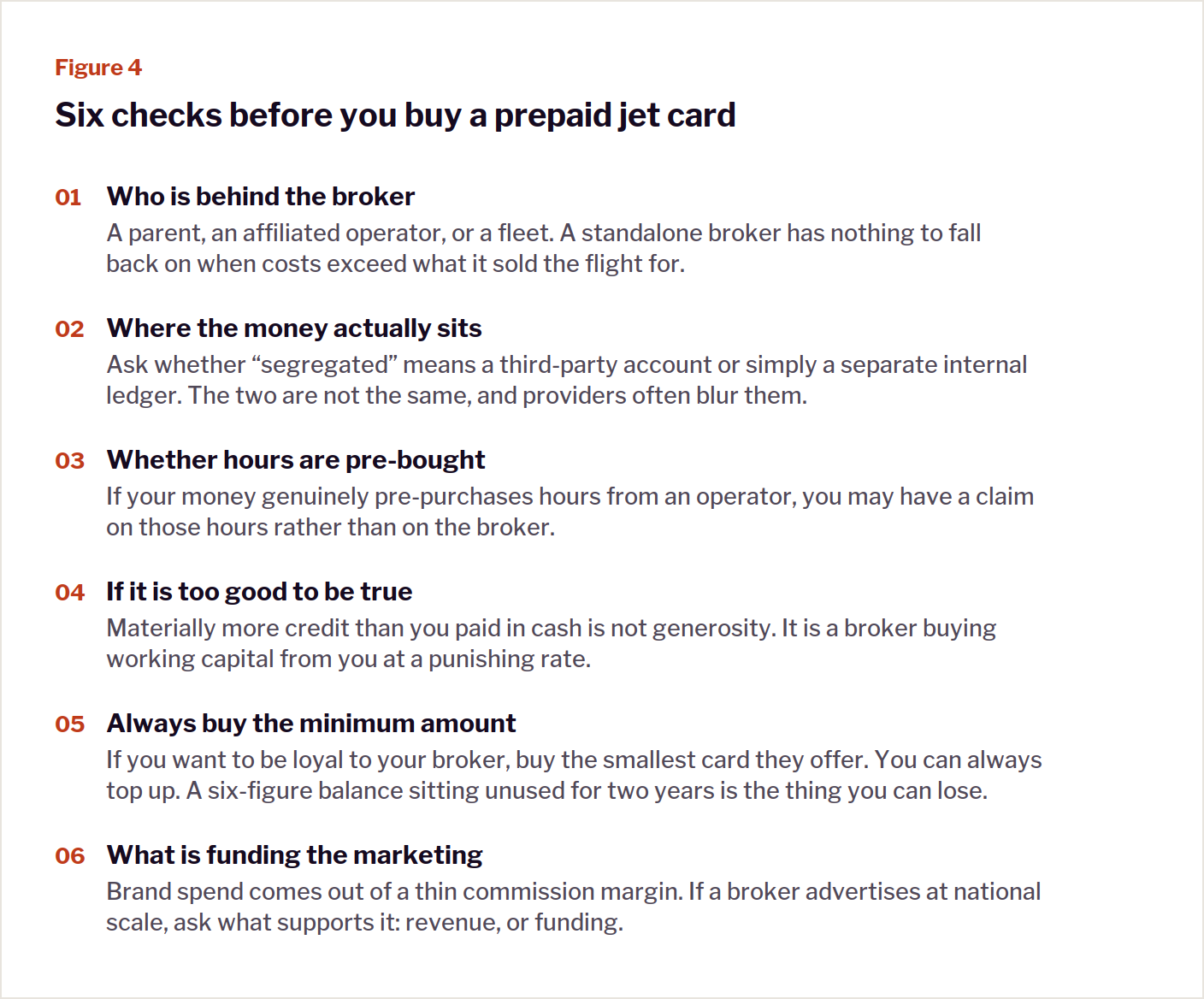
Every broker sells the same thing: a price fixed today against a cost nobody controls. The ones still trading have something standing behind that position. Before you wire a deposit, find out what stands behind yours.
Frequently Asked Questions
What is a broker jet card?
A broker jet card is a prepaid block of flight hours sold by an air charter broker rather than by an aircraft operator. You pay up front for hours at a fixed hourly rate, and the broker buys the flights from third-party operators as and when you fly.
Is my money safe if a jet card broker stops flying?
Often not. Most jet card programmes do not hold customer funds in escrow, so prepaid balances sit in the company's operating account. If the broker fails, cardholders are typically unsecured creditors and rank behind secured lenders.
There could be exceptions to this if it is a reputed broker.
Do jet card brokers hold customer money in escrow?
Rarely. Ask whether segregated means a third-party escrow account or simply a separate internal ledger, because the two offer very different protection.
What happened to ONEflight International?
On 16 September 2026 the Colorado-based charter broker ONEflight International paused all flight activity for 30 days while it conducted a review of its operations. More than $150 million in prepaid customer funds was reported to be at risk. The company had not filed for bankruptcy at the time of writing.
Why do fixed-rate jet cards fail when charter costs rise?
A jet card fixes the price of hours on the day it is sold, but the broker buys those hours later at whatever the market charges. On a 7% gross margin, a 7% rise in charter rates removes the entire margin, and the card cannot be repriced.
What should I check before buying a prepaid jet card?
Check who stands behind the broker, whether your funds sit in a third-party account or an internal ledger, whether hours are pre-purchased from an operator, how deep the prepayment bonus is, whether you can buy the minimum and top up, and what is funding the broker's marketing.
Sources
Doug Gollan, “Over $150 Million At Risk After Jet Charter Broker Suspends Flights”, Forbes, 16 September 2026.
“BAJit private jet broker OneFlight is pausing flights for 30 days”, Private Jet Card Comparisons, 15 September 2026.
“OneFlight ‘actively addressing…financial and operations issues’”, Private Jet Card Comparisons, 9 September 2026.
“OneFlight implements, rescinds a 35% jet card surcharge”, Private Jet Card Comparisons, 25 August 2026.
Stephen Pope, “ONEflight suspends flights with $150M in customer funds potentially at risk”, AeroTime, 17 September 2026.
“Another airline cancels all flights for 30 days amid financial troubles”, TheStreet, 17 September 2026.
“How Much Commission Do Private Jet Brokers Charge?”, Aaliya Jets, 23 May 2026.
Sentient Jet company profile, Private Jet Card Comparisons.
14 CFR Part 295, Air Charter Brokers, Electronic Code of Federal Regulations.
Prior failures, all Forbes: Zetta Jet, Imagine Air, JetSuite, Jet It, Wheels Up, Verijet, AeroVanti.
Heading 1

Heading 2
Heading 3
Heading 4
Heading 5
Heading 6
Lorem ipsum dolor sit amet, consectetur adipiscing elit, sed do eiusmod tempor incididunt ut labore et dolore magna aliqua. Ut enim ad minim veniam, quis nostrud exercitation ullamco laboris nisi ut aliquip ex ea commodo consequat. Duis aute irure dolor in reprehenderit in voluptate velit esse cillum dolore eu fugiat nulla pariatur.
Block quote
Ordered list
- Item 1
- Item 2
- Item 3
Unordered list
- Item A
- Item B
- Item C
Bold text
Emphasis
Superscript
Subscript
Author:

Share on:


Falcon 2000
Falcon 2000 Private Jet
04 November 15 Minutes read
Explore the Dassault Falcon 2000, a versatile private jet known for its efficiency, advanced design, and spacious cabin. Charter with TRIBE for effortless travel.
Heading 1
Heading 2
Heading 3
Heading 4
Heading 5
Heading 6
Lorem ipsum dolor sit amet, consectetur adipiscing elit, sed do eiusmod tempor incididunt ut labore et dolore magna aliqua. Ut enim ad minim veniam, quis nostrud exercitation ullamco laboris nisi ut aliquip ex ea commodo consequat. Duis aute irure dolor in reprehenderit in voluptate velit esse cillum dolore eu fugiat nulla pariatur.
Block quote
Ordered list
- Item 1
- Item 2
- Item 3
Unordered list
- Item A
- Item B
- Item C
Bold text
Emphasis
Superscript
Subscript

The 2024 summer Olympics in Paris and private jet charter: Your complete guide
The Complete Private Aviation Guide for the Paris Olympics 2024
15 July 2024 - 15 Minutes Read
What you need to know if you are flying into Paris for the Olympics
Heading 1
Heading 2
Heading 3
Heading 4
Heading 5
Heading 6
Lorem ipsum dolor sit amet, consectetur adipiscing elit, sed do eiusmod tempor incididunt ut labore et dolore magna aliqua. Ut enim ad minim veniam, quis nostrud exercitation ullamco laboris nisi ut aliquip ex ea commodo consequat. Duis aute irure dolor in reprehenderit in voluptate velit esse cillum dolore eu fugiat nulla pariatur.
Block quote
Ordered list
- Item 1
- Item 2
- Item 3
Unordered list
- Item A
- Item B
- Item C
Bold text
Emphasis
Superscript
Subscript
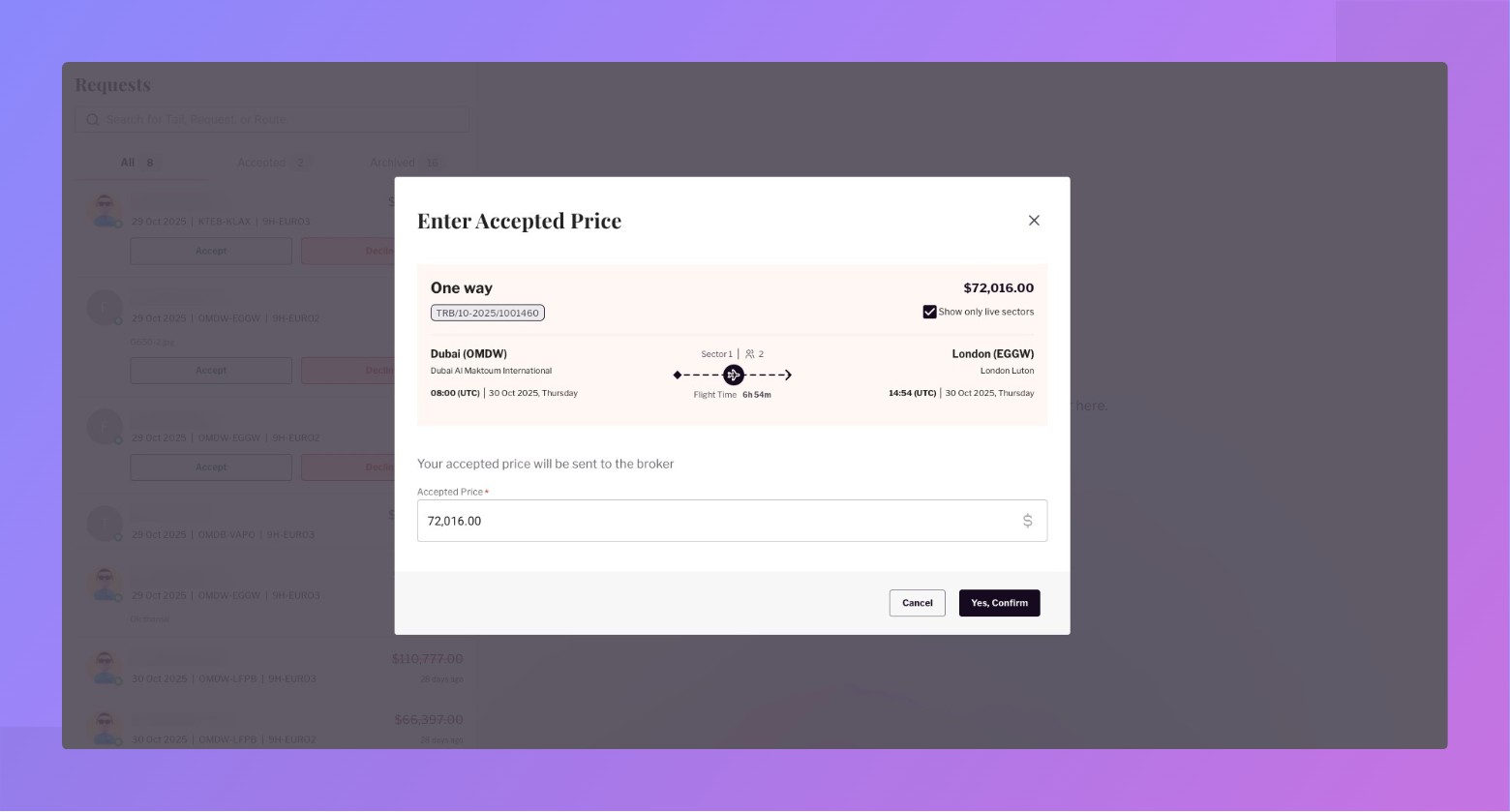
Tribe Demo | Accept Charter Requests in One Click
Heading 1
Heading 2
Heading 3
Heading 4
Heading 5
Heading 6
Lorem ipsum dolor sit amet, consectetur adipiscing elit, sed do eiusmod tempor incididunt ut labore et dolore magna aliqua. Ut enim ad minim veniam, quis nostrud exercitation ullamco laboris nisi ut aliquip ex ea commodo consequat. Duis aute irure dolor in reprehenderit in voluptate velit esse cillum dolore eu fugiat nulla pariatur.
Block quote
Ordered list
- Item 1
- Item 2
- Item 3
Unordered list
- Item A
- Item B
- Item C
Bold text
Emphasis
Superscript
Subscript
